MORN. / MORNING
Samarkand itinerary: what to see in 1, 2 or 3 days
Choose a short stop between trains, a full day among the Timurid monuments or a longer stay with museums and local crafts before continuing to Almaty.
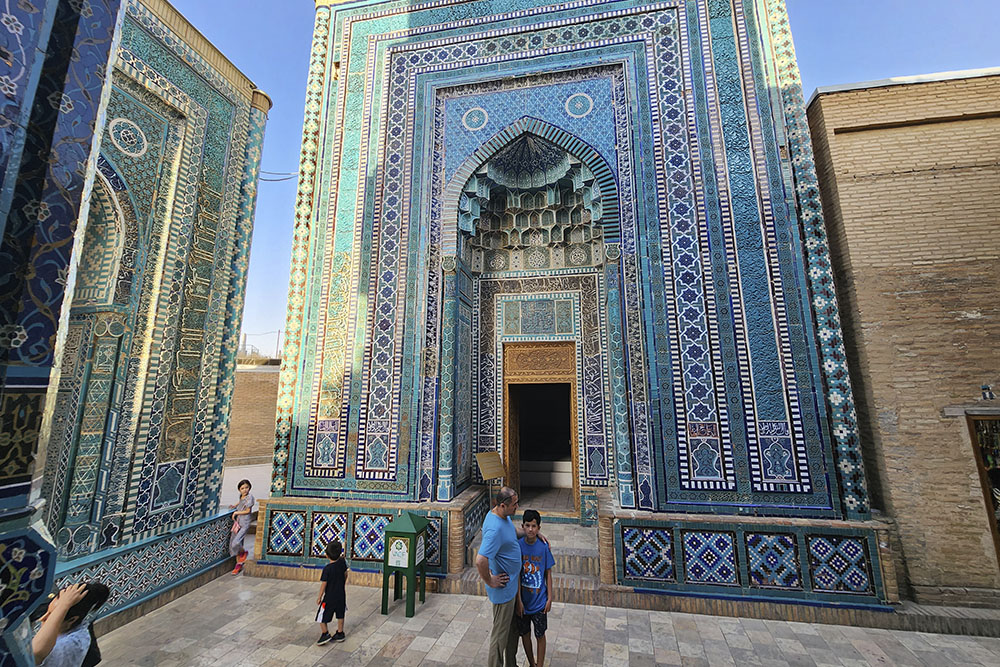
Samarkand is worth more than a quick photograph of the Registan. You can see its main Timurid monuments in one full day, but a second day gives you time for the ancient city of Afrasiab and Ulugh Beg's observatory. A third day lets you choose a working paper mill, a pilgrimage site or a quieter city day before moving on.
If you are travelling through Uzbekistan on the way to Almaty, decide whether Samarkand is a stop between trains or your last Uzbek city. Those are different visits. The former is a race against a railway departure; the latter can include two evenings in the city and a direct flight when it operates.
How many days and nights do you need?
| Time actually available | What fits | Suggested nights if arriving the evening before |
|---|---|---|
| 4–6 hours in town between trains | Registan and either Gur-e-Amir or the bazaar and Bibi-Khanym area | 0 |
| 1 full sightseeing day | Shah-i-Zinda, Siyob Bazaar, Bibi-Khanym, Gur-e-Amir and Registan | 1–2 |
| 2 full sightseeing days | Split the core monuments between two days; add Afrasiab and the observatory | 2–3 |
| 3 full sightseeing days | The first two days plus Konigil, a pilgrimage visit or extra city time | 3–4 |
These are sightseeing days, not a count of calendar dates on hotel reservations. An arrival at 15:00 and departure at 09:00 the next morning give you an afternoon and evening, not two days. To see the necropolis before the crowds and the Registan after dark without rushing, staying overnight is useful.
Arriving in Samarkand: start with the time of your next train
Samarkand railway station is at 3 Abu Rayhon Beruniy Street, away from the historic centre. The main attractions form a walkable cluster, but the station does not belong to it. Save your accommodation and the station as different map destinations. For the ride to the old town, an app-based taxi lets you see a proposed fare before ordering.
If coming from Tashkent, the railway operator's published schedule lists Afrosiyob 766 leaving at 07:21 and arriving at 09:51, and 765 returning at 17:35 and arriving in Tashkent at 20:08. That example leaves 7 hours 44 minutes between station arrival and departure, not eight hours of sightseeing. After both station transfers and boarding time, use the shorter circuit rather than the full-day plan. Buy the outward and onward tickets on Uzbekistan Railways for the actual date. Slower trains can be useful if the high-speed services are sold out.
If you arrive from Bukhara, remember that Bukhara's passenger railway station is in Kagan, not in its old town. Travel with your luggage to Samarkand rather than returning to Bukhara the same evening when the next leg of your journey is eastwards. The budget Uzbekistan itinerary compares city order and train options.
For a short stop with bags, ask your accommodation whether early luggage drop-off is possible before committing to the day. Do not plan to take a large suitcase up the stairways at Shah-i-Zinda. If you have no accommodation, establish a storage option at the station before paying for a sightseeing ticket; a current public left-luggage tariff has not been established.
One day in Samarkand: the monuments on foot
This plan assumes you wake up in Samarkand and have the whole day. The times are planning windows, not fixed tours or admission slots. The core historic route is compact: the local Samarkand itinerary directory places Gur-e-Amir less than a kilometre from Registan and Bibi-Khanym less than a kilometre from Registan along the pedestrian street. You can walk between the main sites and use a car only for a longer transfer or a return when tired.
| Part of the day | Stop | Time to allow |
|---|---|---|
| Early morning | Shah-i-Zinda | 1–1½ hours; more if you are taking photographs |
| Late morning | Hazrat Khizr exterior, Siyob Bazaar and Bibi-Khanym Mosque | 2–2½ hours including the walks |
| Midday | Lunch and a break | 1 hour or longer in hot weather |
| Afternoon | Registan and Gur-e-Amir | 3–3½ hours together, plus walking |
| Evening | Return to the public viewpoint facing the Registan if staying overnight | As much time as you want |
The reverse order also works: start near Gur-e-Amir if your accommodation is there. Keep the necropolis early if avoiding crowds is more important to you than convenience, and do not leave the paid interiors until just before closing in winter.
Shah-i-Zinda: give the staircase and the tilework time
Shah-i-Zinda is a complex of tombs reached through a stairway and a narrow passage between decorated mausoleums. It is also a religious pilgrimage site. Cover shoulders and knees and dress appropriately for the shrine areas. The steps and close-set buildings make this a different visit from looking at a broad square.
Visitors who travelled in May 2026 reported having the passage almost to themselves shortly after 07:00 on a Tuesday. See the admission estimate in the ticket table below. Winter opening may be later; there is no reason to arrive at 07:00 simply because it worked for someone in May. If you dislike queues or want photographs without large groups, this is the stop for which an early start makes the biggest difference.
Siyob Bazaar and the two Bibi-Khanym buildings
From the necropolis area, walk towards Hazrat Khizr Mosque and Siyob Bazaar. The market is a place to buy bread, dried fruit and nuts rather than another paid monument. If visiting on a Monday, market stalls may be less active; do not build your whole lunch plan around a single stall.
The Bibi-Khanym Mosque and Bibi-Khanym Mausoleum are different buildings across the pedestrian street. The great mosque is the longer visit. Its scale is best appreciated from the courtyard, not just the street. The smaller mausoleum is optional if you have a tight schedule. It has a separate ticket.
The July 2026 visitor guide linked in the preceding section describes arriving at the mosque at 22:40 on a May evening and returning twice on the same ticket after a staff member explained the local re-entry arrangement. That experience does not establish a permanent multi-day ticket rule; ask the ticket seller if you intend to return.
For lunch, Samarkand plov is an easy choice around Siyob or in a neighbourhood oshkhona. If you want a long lunch, choose between it and the smaller mausoleum rather than cutting the time inside Registan.
Registan: buy admission once and use the evening separately
Registan Square is the ensemble of Ulugh Beg, Sher-Dor and Tilla-Kori madrasas. The ticketed visit gives you access to the courtyards and architectural interiors, including the richly decorated hall at Tilla-Kori. The outside view across the square is a different, free viewpoint.
The Registan director's statement published by its directorate on 2 October 2025 gives 100,000 UZS for foreign visitors, compared with 15,000 UZS for Uzbek citizens. This remains the figure reported by the local directory in autumn 2026. Official Registan ticket portal. The local directory describes electronic tickets as single-entry; do not assume that a ticket for a morning visit lets you re-enter the paid courtyards that evening.
The directorate's regular visiting hours are 07:00–24:00 from 20 February to 20 November and 08:00–20:00 outside that season. The historic square may be accessible from the public viewpoint even after the paid ensemble closes. Use the main daytime ticket to explore the buildings instead of paying twice just for two different views of their facades.
Gur-e-Amir: a different interior
Gur-e-Amir, the mausoleum of Timur and members of his dynasty, has a ribbed turquoise dome and a gilded burial chamber. Allow roughly an hour. If you have only enough time for two paid sites, Registan and Gur-e-Amir offer contrasting interiors; substitute Shah-i-Zinda for Gur-e-Amir if the tile-lined avenue is the main reason you came.
Two days in Samarkand: separate architecture from the ancient city
With two days, keep Gur-e-Amir and Registan together on the first day, then move north to the bazaar and Bibi-Khanym. Reserve the early part of Day 2 for Shah-i-Zinda instead of fitting it into a crowded afternoon. Use the rest of the second day for two different aspects of the city's history.
Afrasiab Museum and the archaeological area
Afrasiab Museum stands beside the remains of the pre-Timurid settlement. The main reason to go inside is the seventh-century wall painting associated with the ancient city's palace. It depicts a world of diplomatic contacts before the architecture you saw at Registan was built. The excavated landscape outside the museum is different again: do not expect another intact medieval square. UNESCO's account of Samarkand puts the archaeological area, the medieval city and later urban expansion in context.
A solo traveller in a September 2026 trip report felt that the original painting was the main draw and was disappointed by the rest of the museum. If the murals do not especially interest you, an extra hour wandering the city or visiting the observatory may give you more value than another admission ticket.
Ulugh Beg's Observatory
Ulugh Beg Observatory is farther from the centre. Use a taxi between the northern sites if you are trying to fit both in a short afternoon. What survives of the great astronomical instrument is below ground level; the accompanying museum explains its purpose. The observatory is a better match for travellers interested in science and measurement than for those who want another spectacular mosque interior.
If you have time for a third northern stop, the Tomb of Daniel (Khoja Doniyor) is a pilgrimage site near the archaeological area. Otherwise leave it for the next day.
Three days in Samarkand: choose a different experience
A third day is most useful when you add something you have not already seen. The two preceding days cover the principal monumental and archaeological sites. You can choose a craft visit, a pilgrimage or a slower city day rather than adding all three to a single schedule.
Konigil and the Meros paper mill
The Uzbekistan tourism portal describes the Meros paper mill in the village of Konigil outside Samarkand. Here, mulberry bark is processed into pulp and formed into sheets using traditional methods. The working craft is the reason to visit, rather than another collection of monuments. Allow part of a day for the journey and demonstration. Meros Paper Mill, Azizon Street, Konigil is the map destination; do not select a souvenir shop in town with a similar name.
On the map listing, a November 2025 visitor reported paying 20,000 UZS and seeing the papermaking and oil-production processes. Another review describes 110,000 UZS for five people. They are individual prices, not a fixed tariff. For a demonstration or a hands-on session, call the published workshop number +998 90 224 34 96 and ask whether individual visitors can attend, what is operating on the day and what the visit includes. A WhatsApp account for this number is not established. A short visit with a return taxi is enough if you only want to see papermaking; leave more time if you arrange a workshop.
Imam al-Bukhari memorial complex
The Imam al-Bukhari memorial complex lies outside the city. After a large reconstruction it reopened to pilgrims before Eid al-Fitr in 2026, according to an official report of 3 May. It is an important religious destination rather than an extension of the Registan ticket. The complex's visitor information distinguishes general access to open areas from organised visits. There is no confirmed current admission price for every interior; plan the journey according to the areas you intend to visit. Leave the visit for a day without a tight train connection.
Or take another day in the city
University Boulevard and the streets west of the monuments offer a different urban setting from the old-town lanes. A return to the free Registan viewpoint, a long lunch or time at the hostel can be the main plan. You do not need to buy another set of attraction tickets to make a third day worthwhile.
If continuing into Tajikistan, consider whether you want to return to Samarkand after seeing the mountains or travel east and stay in Tajikistan. The three-week Uzbekistan–Tajikistan–Kazakhstan itinerary describes the onward route through Panjakent and the Seven Lakes instead of a return excursion. This is a different journey from spending three days in Samarkand and leaving for Almaty directly.
Tickets, realistic costs and evening opening
For a first visit, budget by the individual places you want to enter. These are per-person foreign-adult planning figures, not a combined pass or a checkout quotation. The 2026 museum ticket listings on iTicket's Samarkand page have displayed starting prices of 71,500 UZS for Gur-e-Amir and the observatory and 77,000 UZS for Afrasiab. Other published prices and reported gate amounts differ. The table uses the conservative visitor-guide references so you can plan your cash; it does not claim those are the exact current counter prices.
| Paid visit | UZS to allow | Basis |
|---|---|---|
| Registan | 100,000 | Directorate's published foreign-visitor price and later local listing |
| Shah-i-Zinda | 80,000 | Published 2026 visitor-guide figure |
| Bibi-Khanym Mosque | 75,000 | Published 2026 visitor-guide figure |
| Gur-e-Amir | 75,000 | Published 2026 visitor-guide figure |
| Ulugh Beg Observatory | 75,000 | Published 2026 visitor-guide figure |
| Afrasiab Museum | 80,000 | Published 2026 visitor-guide figure |
| Bibi-Khanym Mausoleum, optional | 50,000 | Published 2026 visitor-guide figure; separate from mosque |
A two-monument day at Registan and Gur-e-Amir is about 175,000 UZS in admission. Visiting all four principal paid sites is about 330,000 UZS. Adding Afrasiab and the observatory brings the six-site planning total to 485,000 UZS. Food, transport, accommodation, optional monuments and any separately ticketed performance are not included. The market and the outside viewpoint at Registan do not require a monument ticket. If you want to save money, visit fewer interiors rather than pay for tickets you will not have time to use.
Evening opening changed in 2026. The Tourism Committee announcement of 9 September extended the four main museums and complexes it lists to 23:00 and Siyob Bazaar to midnight. That does not establish the opening time of every individual stall or the winter admission conditions at every monument. Registan's winter hours are separately published by its own directorate as above.
The September announcement mentions a daily musical performance at 21:00. A May 2026 visitor saw a Russian-language projection show at 21:00. The directorate also retains a November 2025 winter notice about suspending laser and sound-and-light equipment for repairs. Do not assume the September musical event, the May projection show and a winter performance are the same offering. If a particular show is important to your visit, ask the Registan ticket office about the performance, time, language, price and whether outside viewing is available on your evening: directorate, +998 66 235 70 52. No separate current performance price or winter show schedule has been confirmed.
For a winter visit, leave space for changing conditions. A solo visitor who travelled in January 2026 described cutting short their first Samarkand day because of sleet, then completing more monuments and the museum the next day during snow. Their experience is a reason to split paid visits across two days rather than assign a tight hour to every outdoor stop.
Where to stay for this itinerary
For one or two nights, a base near Registan or Bibi-Khanym lets you reach the centre without ordering a car each morning and evening. Near the station is more useful if your only purpose is an early train and you do not intend to see the old town after dark. Travelling alone? The September 2026 solo traveller mentioned above singled out Old Radio Hostel for its shared spaces. Old Radio Hostel, Bibikhonim Street 15, Samarkand is one candidate to compare with accommodation near the Registan. It is not a guarantee of the guest mix on your dates. A current bed price or verified WhatsApp contact has not been established; the map listing provides the property's available contact channels. If arriving early, ask the property about luggage drop-off; include any tourist levy when comparing your total.
Leaving Samarkand for Almaty
If Samarkand is your final Uzbek city, look for the direct flight SKD → ALA before booking a return to Tashkent. The published route schedule lists FlyArystan FS7880 on Tuesdays and Saturdays for the week of 30 November–6 December 2026 (about 1 hour 50–55 minutes in the air). The airline's route-description page for this direction still states an older season ending 24 October, while its opposite-direction page advertises a longer season. Treat the flight as an option on selected dates, not an available seat on every Tuesday or Saturday. Search SKD → ALA on the carrier's timetable and book only when your departure is offered. Compare the fare with your actual baggage; the FlyArystan cabin-baggage guide explains the separate bag allowances.
For a departure day, distinguish a visit in town from the transfer to Samarkand International Airport. Do not schedule Konigil or the memorial complex immediately before a flight. The best final stop may be breakfast and one short walk near your accommodation.
If the flight does not fit, use the train to Tashkent, then choose the international train, bus or flight. The Samarkand, Bukhara and Khiva to Almaty guide covers the specific connection choices. If you still have time in the Uzbek capital, one to three days in Tashkent can turn the transfer into a planned stop instead of an unproductive wait.
Your first days in Almaty
After the monuments of Samarkand, you may want a change of landscape rather than another sequence of historical buildings. For a solo traveller, a hostel with a common area can make it easier to meet other international travellers before leaving the city. See hostels in Almaty for English-speaking visitors. If you want a city day first, a slow or rainy day in Almaty offers city alternatives. For time among canyons and lakes without renting a vehicle, compare nature trips from Almaty without a car. The seasonal travel guides group the city's longer stays by month, duration and travel budget. Keep the day of arrival separate from your first complete day, especially if you arrive after the morning departures for the lakes.