MORN. / MORNING
Best things to do in Tashkent: a 1–3 day itinerary before Almaty
Spend your time in Tashkent on the old town, modernist architecture and food, with a third day for art, Samarkand or the mountains before continuing to Almaty.
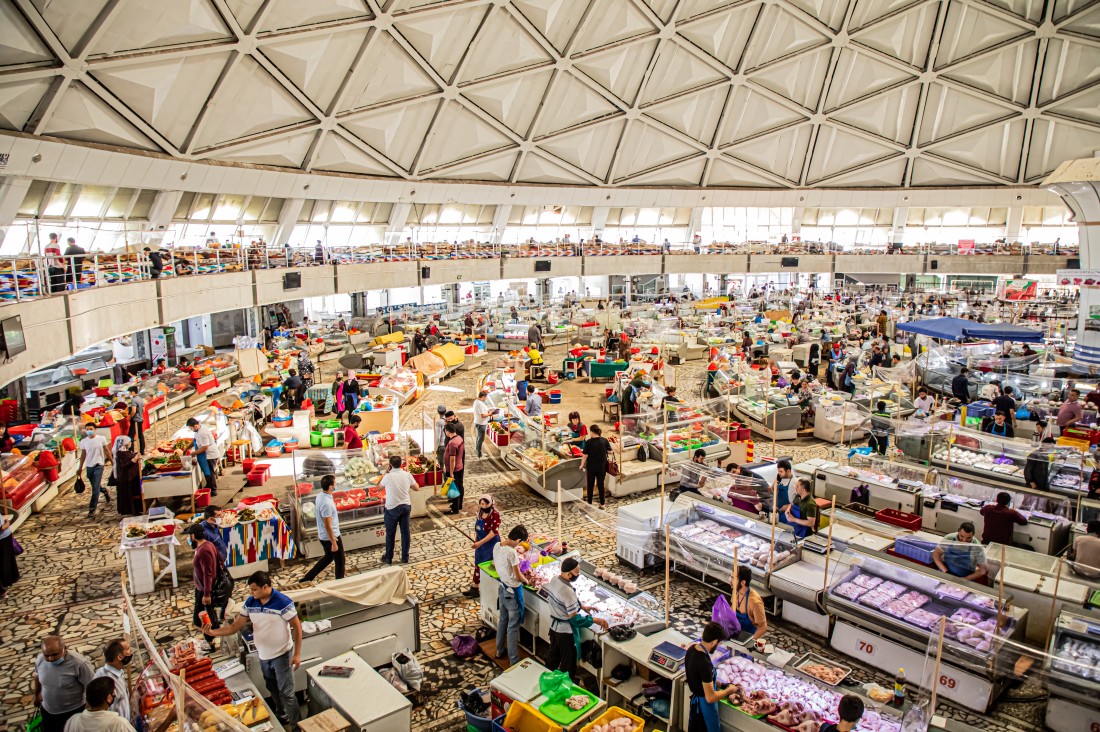
If you are travelling through Uzbekistan on your way to Kazakhstan, two full days in Tashkent give you time for Chorsu Bazaar, the old city's religious architecture, the decorated metro and the modern capital. With one day, concentrate on the old town and the metro rather than crossing the city repeatedly. A third day is worth adding for the city's museums, contemporary art or an outing to the mountains.
There are three reasons not to rely on an older Tashkent itinerary: the famous Uthman Qur'an has moved to the new Islamic Civilization Center, several buildings of the city's twentieth-century modernism became a UNESCO World Heritage property in July 2026, and the Centre for Contemporary Arts opened in September 2026.
How many days should you spend in Tashkent?
| Time in the city | What fits | What to leave out |
|---|---|---|
| One full day | Chorsu and Kukeldash, Hazrati Imam, a metro ride to the centre | A distant excursion; the new museum if you prefer a longer walk and food stops |
| Two full days | The first day's route plus the decorated stations, Amir Temur Square, plov and Minor Mosque | A full mountain day |
| Three full days | Two city days plus contemporary art, Samarkand or a mountain outing | Trying to fit all three extra options into one day |
| Arrival afternoon and an early departure on the third calendar day | One complete sightseeing day and a short arrival-day walk | Treating three dates on the calendar as three usable days |
For an Uzbekistan trip that ends in Tashkent, book your onward connection to Almaty before committing your final sightseeing day. A departure morning is not a full day in the city.
Day 1: Chorsu, the old town and Hazrati Imam
Chorsu Bazaar and Kukeldash Madrasah
Start at Chorsu Bazaar, served by Chorsu metro station on the Oʻzbekiston line. Allow about an hour or more if you want to sit down to eat. The central domed market is easy to recognise; the food stalls and surrounding market streets extend beyond it. Look for the bread ovens, dried fruit, spices and prepared food rather than treating the main hall as the whole bazaar. The national tourism authority's description gives an overview of the food and craft sections.
Try non (round bread), samsa (filled pastry) or a plate of khanum (steamed dough with filling) at a food stall. Ask for the price per portion or weight before ordering, and keep some Uzbek som in cash for stalls without a card terminal. If you are vegetarian, ask whether the filling or rice contains meat or animal fat rather than assuming that a vegetable garnish makes a dish vegetarian.
The nearby Kukeldash Madrasah is a convenient next stop on foot. See the exterior and courtyard if access is available. It is a religious and educational site, so follow local access and dress requirements. It is not the Kukeldash building in Bukhara.
Hazrati Imam and the new home of the Uthman Qur'an
Continue to Hazrati Imam (Khast Imam). A short local ride saves energy if the weather is hot or you do not want to walk across the old-city streets. The architectural ensemble includes the Barak Khan Madrasah, the Kaffal Shashi Mausoleum and mosques. You can appreciate the architecture from the public square without buying a ticket for the new museum next door. Access to individual religious buildings depends on their use and visitor conditions.
Where is the famous old Qur'an now? On 13 November 2025 the Uthman Mushaf was transferred from the Muyi Muborak Madrasah to the Qur'an Hall at the Islamic Civilization Center. Older guides that send you to the former display do not reflect this move.
The new Center at 47 Karasaray Street is a separate museum visit. Its visitor information gives opening hours of 09:00–22:00 daily. The museum covers manuscripts, regional history, science and interactive installations. If seeing the Qur'an is important to you, allow time for admission and the hall itself rather than merely visiting the old religious complex.
Is the Islamic Civilization Center worth the ticket?
The answer depends on whether you want to see the manuscript and exhibitions in depth, or mainly photograph the buildings. These are the adult foreign-visitor prices and formats published by the Center and its authorized ticket seller for late November 2026:
| Admission option | Price (UZS) | What you are buying |
|---|---|---|
| Standard adult | 425,000 | A timed museum visit with an English or Russian audio guide; the ticket seller lists two-hour sessions |
| Individual adult | 660,000 | Independent museum visit, with time until closing |
| Personal guide for a foreign group | 480,000 | A two-hour guide service for up to ten people, additional to each person's admission |
A Reddit user who visited on 18 April 2026 described being taken around in a two-hour guided group and having to leave interactive displays before finishing them. A British traveller reporting their September 2026 visit similarly said that the group pace left little time to look at objects individually. Read the April account and the September report.
The ticket seller's late-November terms distinguish an audio guide from an optional personal guide. The individual ticket explicitly permits independent exploration without the standard two-hour limit. Those published changes matter if the older visitor experiences put you off. They do not establish how every visit is handled on the ground.
If you want a detailed museum afternoon, select the individual format. If the collection is a secondary interest, keep the time for the old-city walk and the metro. Book admission through the Center's visitor page, or ask its admission desk on +998 55 511 23 06 whether your chosen ticket allows you to stop at exhibits and how to reach the Qur'an Hall. Choose the foreign ticket category, not the cheaper resident tariff.
Day 2: the metro, modernist architecture and Uzbek food
Ride the metro as part of the sightseeing
The Tashkent metro is worth experiencing even when you do not need to travel far. A practical sequence if you start near Chorsu is Chorsu → Alisher Navoiy → Kosmonavtlar on the Oʻzbekiston (blue) line in the Doʻstlik direction. Stop to see the decoration at Alisher Navoiy and the space-themed art at Kosmonavtlar without leaving the paid area. To reach Amir Temur Square afterwards, ride back to Alisher Navoiy, use its indoor interchange to Paxtakor on the Chilonzor line and board towards Buyuk Ipak Yoʻli. Get off at Amir Temur xiyoboni. Use the official metro map and the interactive station map for line names and transfers.
Since 1 October 2026, the ATTO fare announcement sets a single electronic journey at 2,500 UZS and a cash-purchased QR ticket at 3,000 UZS. Do not use the 1,700-som fare from older travel reports. Try your contactless bank card at the gate; if it is rejected, buy a single-use QR ticket with cash. A continuous metro ride with internal transfers does not require buying a new ticket each time you change lines or get off a train to see a platform. If you exit through the gates, budget another fare for re-entry.
A British solo traveller who visited in June 2025 called the metro one of the highlights of the trip and found it easy to use. Another traveller, in an August 2026 report on a week-long Uzbekistan trip, described straightforward contactless metro payments and easy navigation. By contrast, the September 2026 British report found ordinary bus routes difficult to work out in English. The metro is a good starting point for independent visitors; save your stops in advance rather than boarding an unfamiliar bus just because it appears to be heading in the right direction. June 2025 report · August 2026 report.
Amir Temur Square and a modernist city walk
At Amir Temur Square, see the equestrian monument, the surrounding public spaces and the distinctive facade of Hotel Uzbekistan. The city centre makes a useful contrast to the bazaar and the older religious architecture. If your interest is Timurid history, the State Museum of the History of the Temurids is beside the square. Current admission and post-renovation visiting details were not established here, so do not build a fixed train or flight connection around a timed entry there.
In July 2026, UNESCO inscribed a group of ten modernist buildings and urban sites, recognising the architecture of the city rebuilt after the 1966 earthquake. Chorsu Market and Kosmonavtlar metro station are among the actual inscribed components. Hotel Uzbekistan is interesting in its own right, but the UNESCO decision identifies it and the TV Tower as possible additions rather than existing components of the property. For a longer architecture walk, use the ten-site list from the Tashkent Modernism initiative.
Eat plov at Besh Qozon and visit Minor Mosque
For a different lunch from Chorsu, visit Besh Qozon, the plov centre beside the TV Tower. Choose this branch, not a similarly named restaurant on the other side of town. Plov, also called osh, is rice cooked with carrots and meat; the large cooking cauldrons are part of the attraction. Come around lunchtime rather than saving the visit for late evening, and check the menu and additions before ordering. The Yunusobod-line map shows Bodomzor station in this part of town. Use the restaurant pin for the final approach.
Continue to Minor Mosque beside the Ankhor waterway. The white-marble mosque opened in 2014; it is a working religious site, not an ancient Silk Road monument. If you are drawn to architecture rather than religious sites, replace this stop with a walk around the city's modern public spaces.
If you choose the TV Tower next to the plov centre, its visitor page describes an observation deck and restrictions on large bags. Check admission for foreign visitors with the tower itself at +998 71 202 35 70, rather than assuming that a resident rate applies. Do not take your suitcase to the tower on the way to the station.
Day 3: choose one more experience
Option A: art and a slower day in the city
For Uzbek textile, ceramics, embroidery and decorative woodwork, visit the State Museum of Applied Arts, whose collection is described by the tourism authority. The published description explains the collections rather than confirming a current foreign-visitor tariff. Do not confuse this museum with the State Museum of Arts. Admission details are not established; if you need a fixed reservation or a free visit, choose the CCA below.
For contemporary art, the Centre for Contemporary Arts Tashkent is an alternative or a second visit. It opened on 6 September 2026 in a converted industrial building dating from 1912. Go to Building B, 6 Amir Temur Street. Admission is free, but advance registration is required. Its published hours are Tuesday–Thursday and Sunday 10:00–20:00, Friday–Saturday 10:00–22:00. It closes on Mondays and on 1 October, 8 December, 31 December and 1–2 January. Choose an available slot before travelling there.
If contemporary art is not your interest, spend the evening walking around Tashkent City Park. A traveller who was there in September 2026 described a lively evening with families and a fountain show; this does not establish a show timetable for other dates.
Option B: a mountain day outside Tashkent
If you are interested in mountain scenery rather than another museum, set aside the full day for one destination, such as Amirsoy. The resort's lift ticket page distinguishes sightseeing gondola tickets from skiing and other passes. Check that your ticket covers the lifts you want and that sightseeing operation is available on your date.
A public transport option is to take a suburban train to Chinorkent railway station, then use the mountain minibuses. Uzbekistan's Ministry of Transport announced routes 324 and 325 from 21 March 2026, serving Amirsoy, Chimgan and Beldersay in the mountain corridor, at 10,000 UZS per ride by card or cash. The 22 August tourism committee notice describes services from 06:00 to 18:30 on ordinary days, with extended holiday operations. This is the published minibus schedule, not the last train back to Tashkent.
Use suburban rail ticketing to establish the outbound and return train before leaving the city. The railway information number is +998 71 237 89 14. Ask about the departure station, the last return from Chinorkent and whether the desired train actually stops there. The November train times were not established, and the minibus schedule alone does not guarantee a connection. If the train return is too early, choose a shorter outing or arrange the return vehicle before going up the mountain.
In a February 2025 skier's firsthand report, the visitor took a train to Gazalkent, paid about CAD 5 for a shared-taxi seat to the lower Amirsoy gondola and returned via shared transport to Tashkent. That experience predates the new minibuses and is not a current fare. It does show why you should identify the lower gondola entrance rather than simply select the resort's upper car park.
Option C: Samarkand if you have not visited it yet
If Samarkand is not already in your itinerary, a return rail day can give you time around the Registan. Search the outward and return trains on the Uzbekistan Railways booking site before buying admission or committing to the excursion. A fast train typically takes roughly 2–2½ hours each way, and you still need to get between Samarkand railway station and the historic centre. It is a long day. If you are about to spend two or three nights in Samarkand anyway, stay in Tashkent instead and continue with your luggage when that leg begins.
What does sightseeing cost?
Here is a small, transparent budget example for one adult foreign visitor; it is not an estimate of all travel expenses.
| Three days, six separately paid metro entries | Cost (UZS) |
|---|---|
| Six electronic metro fares | 15,000 |
| Six cash QR fares instead | 18,000 |
| Electronic fares plus free registered CCA admission | 15,000 |
| Electronic fares plus standard Islamic Civilization Center admission | 440,000 |
| Electronic fares plus individual museum admission | 675,000 |
These examples exclude food, accommodation, taxis, the Applied Arts Museum, mountain transport and the onward journey. You can spend very little on the city's public spaces and metro. The choice of museum ticket changes the sightseeing budget far more than several metro rides. For accommodation close to the station that you will use, see where to stay in Tashkent before Almaty.
Leaving Tashkent for Almaty
Tours in and around Almaty · Fact-checked by Kirill Mountain routes from Almaty · Edited by Askar BakeevThere are three different departure locations. Do not book accommodation or a taxi using the generic word "station".
| Journey | Where to go |
|---|---|
| International train | Follow the station on your ticket; Tashkent Central / North, 7 Turkiston Street is the main station used in the route guide |
| International coach | Tashkent Bus Station, 7 Bunyodkor Avenue, beside Olmazor metro |
| Flight | Tashkent International Airport (TAS); follow the airline's terminal and check-in details |
Compare the full Tashkent to Almaty train, bus and flight guide to choose a departure that fits your last day. If you are travelling elsewhere in Uzbekistan first, see the routes from Samarkand, Bukhara and Khiva to Almaty. If you are still choosing your next country, compare Kazakhstan, Kyrgyzstan and Tajikistan.
Once you know when you arrive in Almaty, reserve at least one full day for the mountains if that is part of your reason for coming. The Kolsai and Kaindy lakes and Black Canyon day trip is a way to visit several landscapes without hiring a car, on an operating departure. The Almaty travel guides help allocate the rest of your days according to the season and your interests.