MORN. / MORNING
Fergana Valley highlights: a 2–4 day independent itinerary
Plan the crafts towns around market days and train connections, then choose whether to continue east into Kyrgyzstan or return to Tashkent.
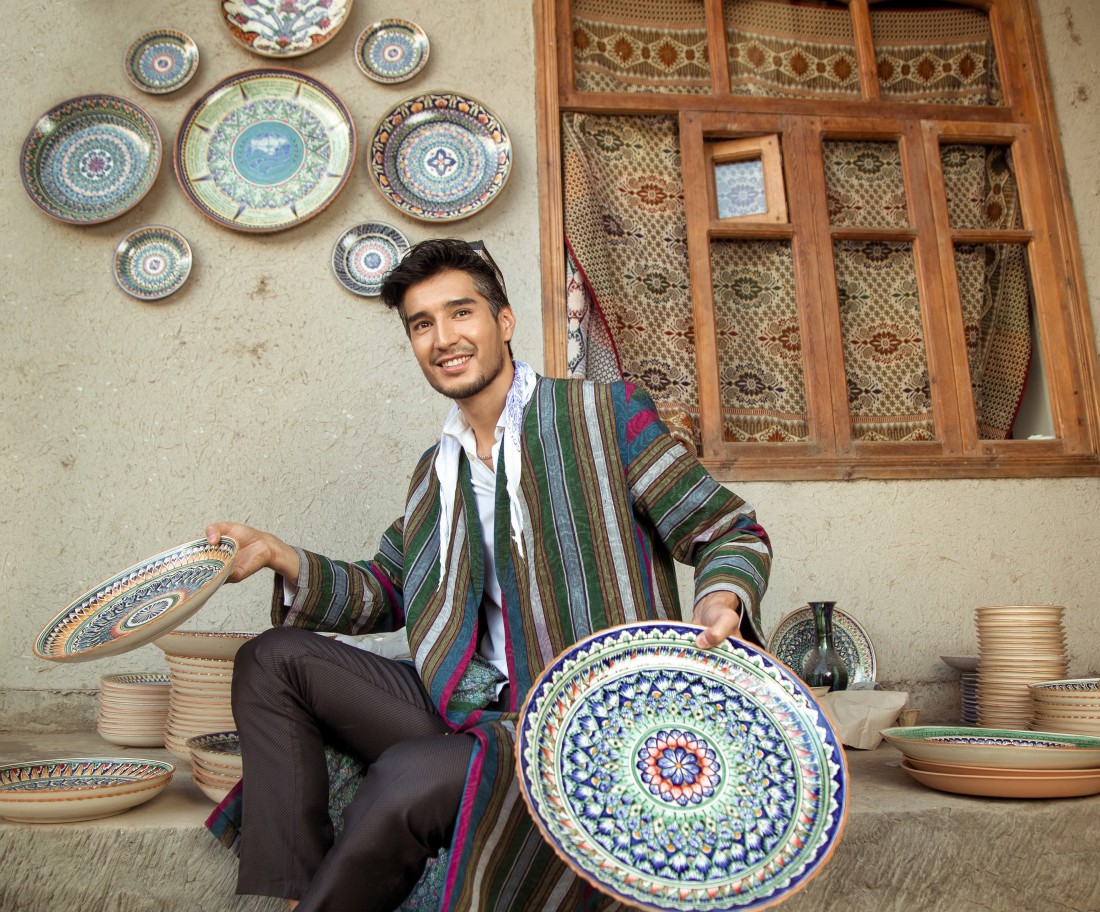
The Uzbek part of the Fergana Valley is a different kind of stop from Samarkand and Bukhara. In Kokand you can see the former khan's palace; in Rishtan you can watch pottery being made; in Margilan you can see how ikat fabrics acquire their patterns before they are woven. The region is worth adding if you want to see craftsmen at work and visit markets that serve local households, rather than spend every day inside historical monuments.
Three days give you time for Kokand, Rishtan and Margilan without a car of your own. A fourth day makes Andijan and the crossing into Kyrgyzstan easier to fit in. If your next destination is Almaty and you do not intend to visit Kyrgyzstan, returning to Tashkent can be simpler than adding another international border.
Choose your route by the market day and your next country
The valley extends beyond Uzbekistan into Kyrgyzstan and Tajikistan, but this itinerary visits the Uzbek towns first. Kokand is on the western side of the route, followed by Rishtan, the Margilan/Fergana area and Andijan farther east. Fergana city and Margilan are separate towns; search for Margilan when using the main railway line.
| Time you have | Suggested route | Where to sleep |
|---|---|---|
| 2 days, 1 night | Day 1 train to Kokand and palace; evening transfer to Margilan. Day 2 market or silk production; depart later | Margilan |
| 3 days, 2 nights | Day 1 Kokand; Day 2 Rishtan and move to Margilan; Day 3 silk and market if the weekday fits | Kokand, then Margilan or Fergana |
| 4 days, 3 nights | Three-day route plus Andijan on Day 4, with an onward crossing to Osh or a return train if time permits | Kokand, then two nights in Margilan/Fergana; alternatively move the final night to Andijan if leaving early |
These are travel-day plans, including the journey from Tashkent on Day 1; they are not all full sightseeing days. For a late train arrival or an early final departure, drop one stop or add a night. The two-day version deliberately omits Rishtan unless you choose it instead of the palace or textile visit.
Put Kumtepa Bazaar on a Thursday or Sunday morning. A local community tourism network identifies those as the market's trading days. The market lies west of Margilan, not in the city centre. If neither day fits your stay, choose a working silk establishment instead. When the market day falls on your Rishtan day, swap the pottery and silk days or move both nights to the same base. There is no need to return to Tashkent simply to change the order of two towns.
For example, arriving in the valley on a Wednesday allows a Thursday morning visit to Kumtepa and a Friday pottery visit. A Saturday arrival allows the Sunday market first. The third day is then available for whichever craft town you have not yet visited.
From Tashkent: the new train and the older timetable
On 10 September 2026, Uzbekistan launched a new electric passenger train on the Tashkent–Andijan line, replacing the former trainset on service 730/729. The regional administration confirmed that the inaugural service left at 09:20 and reached Andijan at 13:35. The four-carriage train serves Kokand and Margilan as well. Tourism Committee announcement · Andijan regional administration's inauguration report.
The following figures are the September launch examples, not a quotation or a timetable for every future date. The published station-company notice gives the intermediate stops at around the times below; September news reports quote the launch fares.
| From Tashkent Central, train 730 | Arrival in the launch schedule | Published launch fare per person |
|---|---|---|
| Kokand (Qo'qon) | about 12:30 | 213,180 UZS |
| Margilan (Marg'ilon) | about 13:02 | 249,840 UZS |
| Andijan (Andijon) | 13:35 | 268,190 UZS |
The return train was announced at 15:38 from Andijan, with arrival in Tashkent at 19:53. However, the railway operator's general timetable still shows 730 at 08:10–14:14 and 729 at 15:09–21:17. The September service is a documented change; the conflicting public listings mean you cannot use either time as a confirmed departure for your date. Select the station, date and exact service in Uzbekistan Railways' ticket system before reserving the hotel or planning a same-day connection. Also compare slower services: they can be useful if the new train is sold out or the price is more important than speed.
Board the train at the station printed on the ticket. For the announced express, that is Tashkent Central railway station, 7 Turkiston Street. Do not assume all trains to the valley leave from Central rather than Tashkent South. Save separate pins for Kokand railway station, Margilan railway station and Andijan railway station. If your hotel is in Fergana city, add the ride from Margilan station.
In summer 2025, Valeriya Goffe travelled with her daughter from Tashkent to Margilan on a train leaving at 08:10 and arriving at 13:20. They returned from Kokand instead of repeating the same station. Her account, published on 3 September 2025, illustrates the advantage of choosing different arrival and departure towns. Their journey predates the replacement express, so its timings are not the current service.
Road travel through the Kamchik Pass is a separate option for people who want to stop at viewpoints or travel directly to a town away from the main railway. The rail route uses tunnels through the mountains. In winter, weather and road conditions can affect the road journey. Do not build a tight train or flight connection around a fixed road time.
Kokand: the khan's palace and wooden-columned mosque
If you arrive by the daytime train, use the afternoon for the former centre of the Kokand Khanate. Start at Khudayar Khan Palace, in Muqimiy Park. Its decorated entrance and surviving rooms show the wealth and craftsmanship of the late khanate. This is a different historical period from the Timurid buildings of Samarkand.
The palace is a museum, so put the interior before the evening walk. A reliable current foreign-adult entrance tariff and last-admission time could not be established from a primary museum price list. The map listing gives the museum telephone as +998 88 795 96 00. Ask about the opening hours and total admission fee for your intended visit, particularly if you arrive late in the afternoon. A park or map opening time does not necessarily mean that all museum rooms are open.
Continue to Jami Mosque. Its early nineteenth-century courtyard has a long wooden-columned porch and a central minaret. The national tourism portal describes 98 carved wooden columns. A look at the painted ceiling and the carpentry explains the building better than just photographing the minaret.
With extra time, choose Norbutabiy Madrasah and the nearby Dakhma-i-Shahan tombs. Access to interiors and religious spaces depends on their use at the time; do not assume a museum ticket includes all of them. If you are stopping in Kokand for only a few hours, the palace and Jami are a manageable pair instead of a checklist of five monuments.
A visitor writing about a 2026 group trip, Jürgen Blösl, found the bazaar in Kokand more interesting than the one he had visited in Samarkand, yet felt that another palace museum offered diminishing returns after two weeks of historical sightseeing. His travelogue shows a useful distinction: if you have already spent several days in museums in western Uzbekistan, allow time for ordinary shopping streets and food in Kokand rather than filling the entire visit with another guided interior circuit.
Stay in Kokand if you want a second morning there or plan to move through Rishtan next. Otherwise take an available onward train or local road connection to Margilan before your market morning.
Rishtan: how to see the pottery, not just the showroom
Rishtan (Rishton) is a pottery town south-east of Kokand, off the main intercity railway. You will need a road leg from Kokand or from the Margilan/Fergana area. The ceramic arts of Uzbekistan were inscribed on UNESCO's intangible cultural heritage list in 2023. That recognition is of a living tradition, not a guarantee that every item in a shop is made using the same technique.
Start at the International Ceramics Centre, Rishtan, plus code 979G+V8H. The district administration reported a professional delegation's visit to the centre and its ceramic museums on 7 November 2026. It is a useful place to see multiple makers' work in one area.
For a closer look at an individual maker's work, Rustam Usmanov's ceramic workshop is listed by the Fergana Regional Tourism Department at 230 B. Ar-Roshidonia Street. The department and map listing both give +998 91 681 23 91. If your aim is to see production rather than buy pottery, ask whether the maker is working that day, whether visitors can enter and whether there is a fee. No current published fixed fee was found.
What to look for when you visit: the shaping of clay on the wheel, decoration before glazing, and a finished fired piece. Some colours change during firing. Ask which stages were completed in this workshop and whether the bowl is intended for food or for decoration. If you want to buy a large plate, ask for its final packed size; you will be carrying it through the rest of Central Asia. Buying a souvenir is optional, not the reason you must be admitted.
Real visitors had different experiences. A Japanese couple visiting on 2 September 2025 watched potters paint designs and were shown the contrast between pieces before and after firing. Their explanations were in Uzbek, so they did not understand all the detail. Their report, published 14 September 2025, includes photos of the workshops. Goffe's summer 2025 visit included a longer encounter with ceramicist Alisher Nazirov and his apprentices. By contrast, the 2026 travelogue above describes a fast factory stop that felt mainly like a sales presentation. Choose enough time at one workshop to watch the actual process; several retail stops in a rushed afternoon are not the same experience.
A low-cost bus option from Fergana
The same Japanese couple used local transport between Fergana city and Rishtan. They recorded a fare of 10,000 UZS for the journey and roughly two hours to reach Rishtan. They identified two boarding locations: central bus stop on Dodhoh Street and the minibus station towards Kokand, plus code 9QRP+32M. They found cash was used on shared buses. Those are observations from September 2025; departure intervals, today's fare, the exact loading point and the last return bus are not confirmed. Show the destination Rishton before boarding.
A budget traveller using this option can stay two nights in Fergana and allocate a day to Rishtan. It makes less sense to travel two hours each way and also expect to watch the entire silk process that afternoon. A direct road ride from Kokand to Rishtan followed by a ride towards Margilan instead avoids returning to your western starting point. Confirm the onward car or minibus before committing to a late stop.
Margilan: silk factory, crafts centre and the market
Start with what you actually want to see: the manufacture of fabric, finished textiles for sale, or a busy local market. These experiences happen in different places.
Yodgorlik Silk Factory and museum
The Yodgorlik manufacturer lists its address as 138 Zahiriddin Street, Margilan and its operating hours as 08:00–17:00, seven days a week. Open the factory on the map. The factory was established in 1972 and is known for traditional silk production. A visit can help you understand why patterned threads are tied and coloured before weaving. Not all stages necessarily take place during a visitor's chosen hour.
For a visit that depends on seeing the production process, call +998 90 561 01 05 or write to yodgorlik.uz@gmail.com. The manufacturer publishes operating hours but not a visitor admission price or a schedule of demonstrations. The hours alone do not establish that the whole production process can be seen on Sunday. Independent entry prices reported online disagree, so treat any guided-visit fee as separate from general entry until the factory confirms it.
Said Ahmad Khoja Madrasah
A second place to see textile craft is the Margilan Crafts Development Centre at Said Ahmad Khoja Madrasah. UNESCO describes the centre's work to preserve and teach atlas and adras production. Its safeguarding programme was recognised in 2017. This centre is not the Yodgorlik factory: it is a separate location with artisan workshops. UNESCO's account of the centre also describes embroidery, block printing and other crafts. If a particular demonstration is important to you, arrange the visit in advance rather than assume a workshop will be staffed all day.
Kumtepa Bazaar
On Thursday or Sunday, go to Qumtepa/Kumtepa Bazaar, west of Margilan early in the morning. It is a working market where people from the surrounding area sell and buy fabric, clothes, fruit, bread and household goods. Allow an hour or two rather than expecting to find the silk stalls immediately. Carry small UZS notes.
In the textile rows, compare fibre composition, fabric width and price per metre before a piece is cut. Atlas and adras are not interchangeable labels for every brightly patterned cloth; the material and manufacturing method matter if you are paying for handmade silk. A scarf is easier to carry onward than several metres of heavy fabric. The factory and the crafts centre offer a different way of understanding the textiles than a purchase in the market.
If the market is a priority, sleep in Margilan or Fergana the previous night. A train arriving from Tashkent at midday misses the morning trade even if it is the right day of the week. Start with the bazaar, have lunch in town and visit the factory or craft centre at the time that matches their actual work.
Where to stay and how to travel between the towns
A single base works for travellers who prefer leaving luggage at their accommodation. Fergana city has urban hotels and cafés, and Margilan is closer to the silk sites and main-line railway station. Kokand is more convenient for the palace and an eastbound departure the following day. If you want to continue to Osh, Andijan is a useful final overnight stop rather than a base for backtracking to Rishtan. Search around the map pins for the attractions you will actually visit, not just a city name.
For travellers focused on the production side of silk, Yodgorlik's own website also lists a small seven-room hotel. Room availability and total prices are not published there. The same official phone and email can be used to ask about check-in, registration and total accommodation charges if you want to stay there. No claim that the hotel is a hostel or has a particular international guest mix is supported.
Local rail fares and the direction of the loop
For longer moves within the valley, compare intercity trains with the official suburban rail ticket portal. The suburban operator's announcement effective 16 October 2026 lists the following adult tariffs for named routes:
| Suburban route | Published adult fare |
|---|---|
| Kokand – Margilan – Andijan | 15,000 UZS |
| Kokand – Andijan – Margilan – Kokand | 20,000 UZS |
| Kokand – Namangan | 15,000 UZS |
These are the operator's route tariffs, not a guaranteed price for every pair of intermediate stops. They apply to the suburban trains, not the replacement express from Tashkent. Official tariff notice.
The May 2026 local schedule describes a clockwise service travelling from Kokand through Namangan to Andijan, then Margilan and back to Kokand. Its published segment Andijan 10:50 → Margilan 12:02 is a 72-minute scheduled example. Margilan → Kokand is the next part of that loop, not Margilan → Andijan. Read the direction, not only the station names. The operator announced a one-day suspension on 11 November for technical reasons; that cancellation is not a claim that the train is suspended today. Use the ticket portal and the operator's notices for departures on your date. Its public telephone is +998 71 237 89 14. No date-specific suburban seats or fare between individual intermediate stops were established.
A useful distinction: rail can handle the long moves, but Rishtan and Kumtepa still require a local road connection. If you need an exact arrival time for a museum or a border, a shared car that departs when full is a different proposition from a booked train.
Andijan: Babur's birthplace before crossing into Kyrgyzstan
With a fourth day, continue east to Andijan. The city is the birthplace of Zahiriddin Muhammad Babur, the founder of the Mughal dynasty in India. Visit the Babur Memorial Park on Bogishamol Hill. The memorial includes a museum and a symbolic tomb. The national tourism portal's description places it about seven kilometres from Andijan. Allocate a separate ride and enough time to get back to town. The regional administration announced a new Baburids Memorial project on 28 September 2026; the project announcement is not evidence that its new museum is already open. Official project information.
If you have only a few hours before leaving Uzbekistan, the memorial and a meal are a reasonable half-day. If you are boarding an evening onward service, keep the city stop separate from any time you need for crossing the border. Add another night if visiting the museum would force you into a very late arrival in Osh.
From the Fergana Valley to Almaty: via Osh or back through Tashkent
Routes across the Kyrgyz border · Edited by Askar Bakeev Kazakhstan law · Reviewed by legal consultant Guliya AitbayevaVia Kyrgyzstan. If you want to explore Osh, southern Kyrgyzstan or the rest of the country, finish in Andijan and use the Dustlik–Dostuk international crossing. The Kyrgyz Digital Border portal lists Dostuk as an international road and pedestrian checkpoint with round-the-clock hours. This is the checkpoint's listed status, not a guarantee of a short queue or a right to enter with every passport. Do not confuse it with a nearby bilateral crossing that may have different access rules.
A July 2025 traveller recorded taking a local bus from Andijan bus station to the Uzbek side of the border for 8,000 UZS in cash, with a journey of just over an hour. They then crossed on foot and used a car on the Kyrgyz side. Original account. This was not a confirmed through 777 service. An account of travel in the opposite direction, from Osh to Andijan around late September 2026, reports a 150 KGS fare on the 777, but that does not establish the same route, timetable or price from Andijan today. Discussion with the traveller's later report. The two-stage approach remains useful when you cannot establish a through departure. See the country-choice guide after Uzbekistan for the longer journey and the differing experiences.
Osh uses a clock one hour ahead of Andijan; Kazakhstan and Uzbekistan use UTC+5, Kyrgyzstan UTC+6. Read the departure and arrival in their own local time. You need an entry basis for Kyrgyzstan as well as Kazakhstan. Check the official conditions for your passport before selecting a land route. Kazakhstan's e-visa guidance limits electronic-visa entry to international-airport checkpoints. A domestic flight from Osh to Bishkek followed by a bus does not turn the Kazakhstan border into an airport entry.
From Osh, compare a domestic flight to Bishkek and an onward bus or flight to Almaty using the Osh to Almaty guide. If you are taking longer to explore Kyrgyzstan, the Kyrgyzstan to Almaty guide compares the final legs from Bishkek, Issyk-Kul and Karakol. Do not assume an unconfirmed nonstop Osh–Almaty flight or an immediate same-day combination.
Via Tashkent. If you are going straight to Almaty and have no plans in Kyrgyzstan, return by a train that stops at the valley town where you are staying. From the Tashkent arrival point, compare the international train, flight or coach in the Tashkent to Almaty guide. Finishing in Margilan rather than Andijan saves an unnecessary eastward leg when you are turning back west. Search for the onward ticket first, and schedule the domestic arrival so there is time for a station or airport transfer. If you are still planning the western Uzbek cities, use the independent 7–14 day Uzbekistan itinerary before deciding how many days to add in the valley.
First days in Almaty
After several days moving between Uzbek craft towns, choose accommodation and sightseeing according to the kind of stay you want in Almaty. For travellers who want to meet other international visitors, the guide to English-speaking hostels in Almaty compares their guest mix and booking contacts. For a quiet city day, see the Almaty slow or rainy-day itinerary. If you have time to go beyond the city, the guide to nature trips without a rental car compares nearby walks, the lakes and canyon journeys. Choose your month and number of full days in the Almaty travel guides. That leaves the border and long intercity travel days separate from the days you actually spend in the city.