MORN. / MORNING
Bukhara itinerary: what to see in one or two days
See the Silk Road old town on foot, choose the museums worth your time and decide whether to stay overnight or continue east towards Almaty.
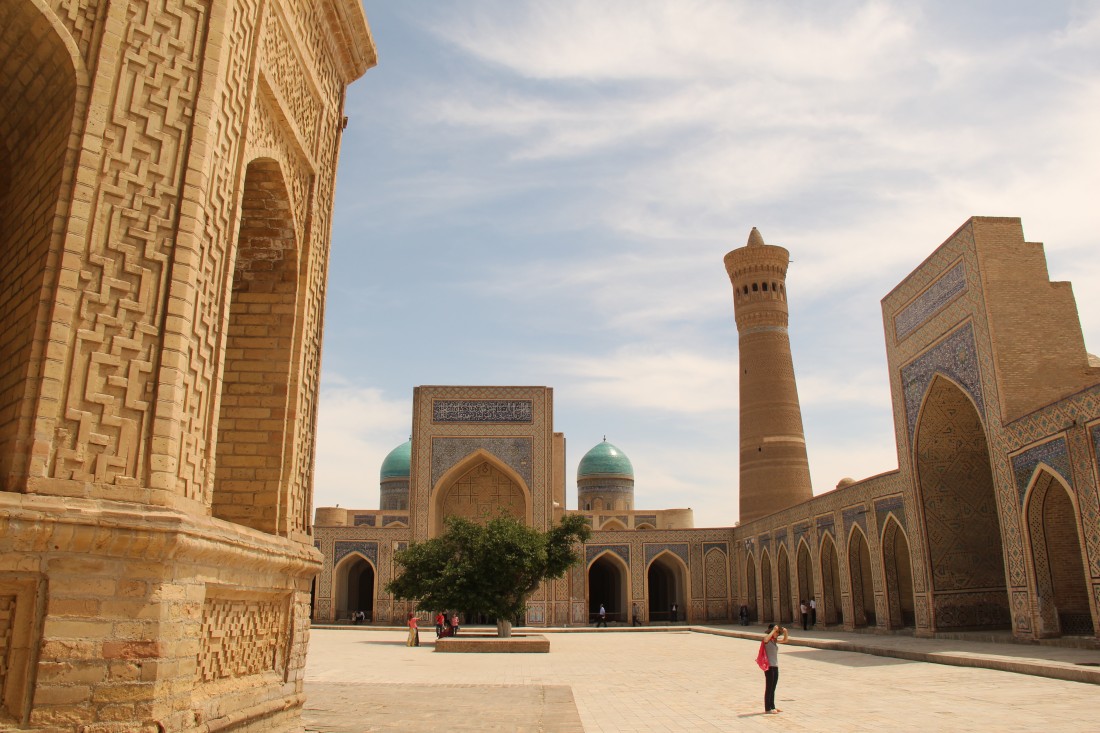
One full day in Bukhara is enough to walk through the old trading streets, see the Kalyan Minaret and explore the Ark fortress. With a second day, you can spend longer in the city's museums or go out to the last emir's summer palace instead of rushing between monuments.
Bukhara works well as a stop on an eastbound journey from Khiva towards Samarkand, Tashkent and Almaty. Its railway station, however, is in another town. If you only have a few hours between trains, count the transfers at both ends before deciding which buildings to enter.
How many days and nights do you need?
| Time available | Plan | Accommodation |
|---|---|---|
| 4–6 hours in the old town | Lyabi-Hauz, trading domes and Poi Kalyan; add the Ark if its opening hours allow | None required if your onward train works |
| One full sightseeing day | Ark, Bolo-Hauz, Samanid Mausoleum, Poi Kalyan and the eastern old town | One night if you arrive early or leave late; two for an uninterrupted day |
| Two full sightseeing days | Day 1 old-town circuit; Day 2 merchant houses, Chor Minor or the summer palace | Two nights with suitable trains, otherwise three |
Arriving at 14:32 from Khiva and leaving the following morning does not give you two sightseeing days. It gives you one afternoon and an evening. The distinction matters because the old-town streets remain accessible after the museums have shut, but you cannot use an evening walk to replace a daytime visit inside the Ark.
Arriving at Bukhara-1: the station is in Kagan
Select Bukhara (Buxoro) in the Uzbekistan Railways ticket system. The main passenger station is Bukhara railway station in Kagan (Kogon), not in the old town. Save this station map pin separately from your accommodation. Kagan is a separate town to the south-east of the historic centre; choosing a hotel simply because it is near the station will change how you spend your sightseeing time.
A traveller who left Bukhara on 1 September 2026 described ordering a car after checking out around 09:30 and reaching the station around 09:50. The same report describes boarding a train towards Tashkent later that morning. Read the account. That is one journey in light traffic, not a fixed transfer time.
Taxi from the station. Use Yandex Go to see a fare for your actual destination before accepting a ride. In a trip report published on 27 September 2026, a visitor described persistent taxi offers on arrival, dropping from US$10 to $5 and then $2. Rather than accept an unsolicited offer, she moved to a nearby hotel and ordered a car through the app. The ride to her hotel in the old town took about 20 minutes. Read her arrival account. Those offers were not regulated fares. Compare the app quote with the price for the whole car, and establish where it will drop you if your guesthouse is on a pedestrian lane.
Public transport. The map lists bus 68, bus 378 and minibus 236 at the outbound Kogon – Temir yo'l vokzali stop, on Bukhara Avenue. Bus 378 is shown heading towards Chorbakr/Jondor stoyanka via Bukhara. For the return journey, Markaziy bozor on M. Karimov Street lists the same route towards Kogon railway station. The stop links distinguish directions; open the live journey for your actual accommodation. A reliable current fare and door-to-door duration were not established. This is useful for a stay of a night or more; a direct car saves time when your next train is close.
Bukhara between trains: where to leave your luggage
You do not have to book a room solely to avoid carrying your bags through the old town. A traveller arriving from Samarkand and leaving for Tashkent on an overnight train described using the station's luggage storage for 10,000 UZS per item. Their report was published on 23 September 2026. They then used Yandex Go, visited the city on foot and came back for the train. The storage was available until their departure that evening. Read the full trip report.
An independent April 2025 discussion also contains an account of using the station's storage. Another traveller reported leaving luggage at a hostel. Neither account establishes that the railway storage operates around the clock. On a no-hotel visit, establish its closing time, current charge and collection procedure at the station counter before leaving. The above price is an observed payment, not a current published tariff.
For a return day trip from Tashkent, the railway operator's published timetable illustrates why this is more demanding than a stop on the way from Samarkand. It lists trains 778 and 777 on Fridays, Saturdays and Sundays: Tashkent 06:03 → Bukhara 10:14, then Bukhara 17:55 → Tashkent 22:06. That is 7 hours 41 minutes between arrival and departure at the station. Two transfers of 25 minutes and a 40-minute station allowance, as a planning assumption, leave 6 hours 11 minutes at most before allowing for luggage collection and any waiting. The official ticket portal and timetable can display different schedules, so use the trains actually sold for your date, not these example numbers as a guaranteed connection.
For that limited visit, start with the Ark while it is open, walk to Poi Kalyan and finish at Lyabi-Hauz if the time allows. Skip the summer palace. If your return train leaves before sunset, enjoy the public square in daylight; you do not need a second trip across town for an evening photograph.
Day 1 morning: the Ark, Bolo-Hauz and the western monuments
Start at the Ark fortress, 2 Abu Hafs Kabir Street, rather than in the souvenir shops. The citadel was the residence of Bukhara's rulers until 1920. Behind its walls are courtyards and museum displays covering the region's history, archaeological finds, coins and more. This is not just an exterior photo stop. Allow about 90–120 minutes as a planning estimate.
The state museum-reserve's Ark page lists daily opening, ordinarily 09:00–18:00; on Tuesday, Wednesday and Sunday the published hours are 09:00–17:00. It also lists an extended seasonal schedule of 08:00–21:00 without defining the season. The published foreign-visitor admission tariff, in force from 1 January 2025, is 60,000 UZS. For a late visit or seasonal opening question, the museum lists a telephone contact. If you want a view over the old town, the visitor who made the station-storage stop above reported being able to reach an elevated viewing area inside the fortress; access to particular parts of the walls may change.
Across the road is Bolo-Hauz Mosque. Look at the carved wooden columns and the pool from outside. If services are taking place, continue the walk rather than assuming you can enter a functioning place of worship.
Continue to the Samanid Mausoleum. This compact building is the architectural contrast to the large tiled facades elsewhere in the old town: its patterns are built into the brickwork. The UNESCO World Heritage description identifies it as a particularly important surviving monument of tenth-century architecture. Spend time walking around all sides before leaving the park. The mausoleum is not on the museum-reserve's published admission tariff; a current interior entry price and hours are not confirmed.
If you enjoy small museums, Chashma-Ayub is a nearby choice: the museum-reserve's tariff lists its water-supply history exhibition at 20,000 UZS. The Zindan, the former emirate prison near the Ark, is another separate 20,000 UZS museum. Choose whichever subject interests you rather than buying every ticket along the way.
Day 1 afternoon: Poi Kalyan, the trading domes and Lyabi-Hauz
Walk east from the Ark towards Poi Kalyan. The public square is framed by the Kalyan Mosque, the Kalyan Minaret and the Mir-i-Arab Madrasa. There is a difference between standing in the square and entering each religious building. Seeing the minaret from below is part of the free outdoor visit; do not plan on climbing it. Mir-i-Arab is a working religious school, so do not assume unrestricted access to its courtyard and study rooms.
The state museum-reserve's tariff does not include the Kalyan Mosque. A map reviewer writing in January 2026 reported paying 15,000 UZS for mosque sightseeing. That is an individual reported price, not today's official ticket. Bring some Uzbek som for separate admissions; cover shoulders and knees and follow the entrance arrangements around prayer time.
The pair of Ulugh Beg Madrasa and Abdulaziz Khan Madrasa is a useful comparison of different decorative styles. The museum-reserve publishes separate 20,000 UZS tariffs for the calligraphy and woodcarving exhibitions. Buy an interior ticket for the exhibition you want to visit, not because you need a pass to walk past the buildings. The same tariff lists the carpet exhibition at Magoki-Attori Mosque; the present exhibition access was not established, so it is not a scheduled stop in this route.
Between the madrasas and Lyabi-Hauz, walk through the historic trading domes, including Toqi Zargaron and Toqi Telpak Furushon. You can look at textiles, embroideries, metalwork and other goods without buying them. If a product's origin or method of manufacture matters to you, ask the maker or seller before paying; an old building does not establish that everything sold inside was handmade there.
End near the pool at Lyabi-Hauz, with the Nadir Divan-Begi buildings and Kukeldash Madrasa around it. This is a convenient place to stop for tea or dinner before a short walk back to your accommodation. For the evening view, return to Poi Kalyan. A visitor's September 2026 report described finding the illuminated square busier and noisier than during the day. Go earlier if you want quiet architectural photographs; stay into the evening if you prefer the lively atmosphere.
Day 2: choose the summer palace or more of the old town
Option A — Sitorai Mohi-Khosa, the last emir's summer residence
The best contrast to the religious monuments of the first day is Sitorai Mohi-Khosa, the country residence of Bukhara's last emir. The museum's official description identifies the site as 47 Makhasa Avenue and dates the surviving newer palace complex to the period 1912–1918. Interiors and garden pavilions display furnishings, porcelain, historic clothing and embroidered textiles. It is outside the old-town walking circuit.
The published foreign-visitor ticket is 60,000 UZS. The museum lists the same hours as the Ark, with a 17:00 close on Tuesday, Wednesday and Sunday; telephone +998 65 228 50 47. Allow roughly half a day including travel and time in the buildings. Order a car to the museum and arrange your return. You can still spend the second afternoon around Chor Minor or in a favourite part of the old town. If you are catching a train that afternoon, allow for collection of your luggage and the separate Kagan transfer; do not treat the palace as a stop on the station route.
Option B — more city time without another car ride
Start at Chor Minor, a small four-towered building among residential lanes east of Lyabi-Hauz. It is worth seeing from outside. A current tariff for roof access was not established; do not pay for a roof visit unless it is actually available and you want it. Continue back towards the pool and choose the museum or street you missed on Day 1.
For a different interior, the Fayzulla Khojaev House Museum shows the scale and decoration of a wealthy nineteenth-century merchant's home. Its foreign-visitor admission is listed at 30,000 UZS under the merchant house museum in the museum-reserve tariff. It is a separate ticket from the fortress. This option makes sense if you are more interested in everyday life and domestic architecture than a further palace visit.
A second day does not have to mean a longer list of buildings. One solo traveller, writing in September 2026 after travelling across Uzbekistan, found the large cities possible to visit quickly but particularly enjoyed staying longer in Bukhara because of the common space at Dervish Hostel. Read the travel report. If meeting other travellers or spending time with local artisans matters more to you than a second museum circuit, choose the slower day.
Entrance fees: budget for the places you actually enter
These examples use the published museum-reserve admissions for foreign visitors, without optional photography, transport, food or accommodation. They are subtotals, not all-inclusive sightseeing passes.
| Choice | Museum admission subtotal |
|---|---|
| Ark only, with an outdoor old-town walk | 60,000 UZS |
| Ark + Chashma-Ayub or Zindan + one madrasa exhibition | 100,000 UZS |
| The preceding three museums + merchant house | 130,000 UZS |
| The preceding four museums + summer palace | 190,000 UZS |
Add the actual separate admissions at sites not covered by the tariff, if you enter them. The same museum-reserve publishes a charge of 30,000 UZS for photographing exhibits, 100,000 UZS for video with a camera, and a 20,000 UZS audio-guide service. The price list does not establish that every museum offers the audio guide in English or how ordinary phone photography is treated. Ask at the museum ticket desk if those services affect your choice. You can spend a full day walking the historic streets without buying a ticket to every building.
Where to stay for a short visit
For one or two days, stay inside the walking area rather than near the railway station. Lyabi-Hauz is useful if you want to step outside for food in the evening; the lanes around Poi Kalyan and the Ark work well if you want to start with the western sights. If a car cannot reach your guesthouse door, ask where to get dropped off and how far you will need to carry your luggage.
For a hostel-based stay, Dervish Hostel, 11 Quyi Darakht Street, is a concrete candidate with dormitory accommodation and a shared kitchen. The map listing gives +998 90 711 08 00 and lists a luggage room. The September 2026 solo traveller described above liked its shared space. A local accommodation directory gives check-in from 14:00 and check-out by 12:00; ask for the total price for your dates, including any tourist levy, and whether luggage can be left before check-in or after check-out. No verified current bed rate or WhatsApp contact is available. The telephone number is a published contact, not confirmation that WhatsApp is supported.
For the short-stop scenario, accommodation is not required if you have a confirmed onward train and an arrangement for storing your bags. If you are arriving after midnight or leaving early in the morning, arrange the actual check-in time and station ride before paying for a room; a listing marked open 24 hours does not by itself settle those terms.
Leaving Bukhara towards Almaty
If Khiva is still on your list, visit it before heading east when the rest of your trip ends in Kazakhstan. Uzbekistan's Tourism Committee announced the new Khiva–Bukhara trains from 9 September 2026. Train 707 was scheduled to arrive from Khiva at 14:32 after leaving at 09:55, except Tuesdays. Train 706 in the opposite direction was scheduled at 15:45 → 20:25, except Mondays. These are published launch schedules; use the ticket system for the date you travel. An arrival on 707 fits the short afternoon circuit or the beginning of a two-night stay.
Once Bukhara is your last western city, you have two practical eastbound choices:
| Your remaining trip | Next step |
|---|---|
| Samarkand is still on your list, or a suitable direct SKD–ALA flight is available | Bukhara → Samarkand by train; continue from there on your actual flight date |
| You want the widest choice of Kazakhstan connections | Bukhara → Tashkent by train or a bookable air itinerary; continue to Almaty by your chosen mode |
The Bukhara-to-Almaty section of our Uzbekistan transport guide compares the routes, including flight connections and station logistics. It also explains why buying separate domestic and international tickets for the same day is not always possible. Do not spend an extra night in Samarkand solely to chase a direct flight that is unavailable on your date. If travelling through the capital, use the Tashkent to Almaty train, bus and flight guide before fixing the last departure from Bukhara. To plan the rest of your Uzbek stay, see the 7-, 10- and 14-day backpacking itinerary.
First days in Almaty
The next part of your trip can be quite different from the Silk Road cities. If your time in Bukhara was mostly spent walking around monuments, allow time for a city walk and a day outside Almaty rather than another sequence of museums. For a social hostel stay, compare the Almaty hostels for English-speaking travellers. If you arrive late or have an early train arrival, settle your luggage and accommodation before planning your first outing.
With two full days, one can be spent around Panfilov Park and the Green Bazaar, with the other for a trip towards the mountains or one of the nearby nature areas. Compare nature trips from Almaty without a car to see which options fit your time and transport preferences. If you have more days, the Almaty Travel Guides compare stays by season and duration. Count actual full days rather than the number of dates in your flight reservation, just as in Bukhara.