MORN. / MORNING
Souvenirs from Almaty: chocolate, design and jewellery worth choosing
Choose gifts in Almaty with real shop links, travellers’ chocolate experiences and practical checks for ingredients, makers, materials and packing.
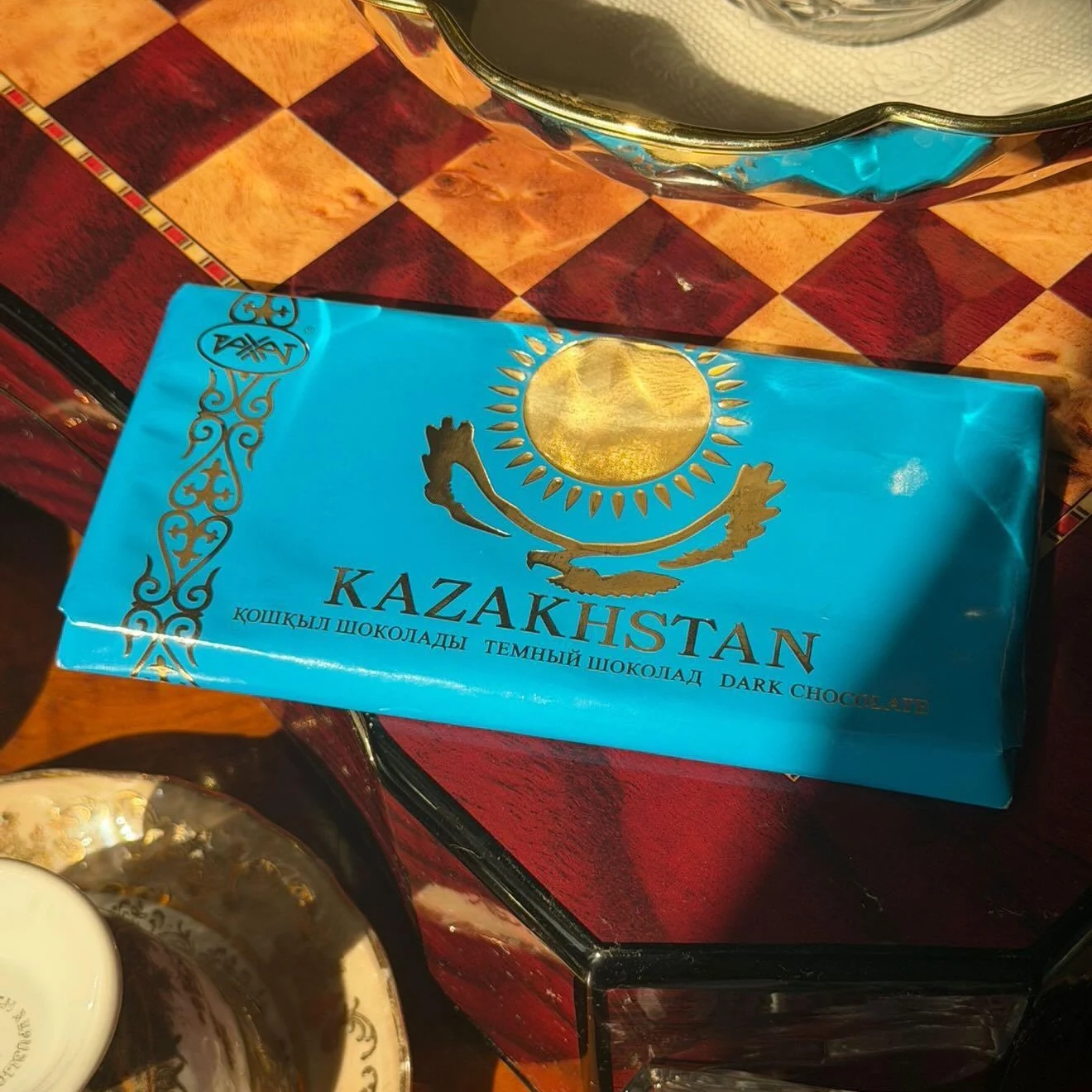
A good Almaty souvenir can be something to share over tea, a small object for home or a piece of jewellery someone will actually wear. Choose the recipient first, then leave a little time to look closely at the item. A familiar ornament on the front tells you less than the maker, material or ingredients behind it.
More than a souvenir. Your choice. A gift can reflect a taste you enjoyed, a maker’s work or a detail that caught your eye.
A new discovery, or a familiar favourite? If you want to repeat a gift someone enjoyed, look for its exact name and variant; a new gift need not be chosen for rarity alone. If you are choosing together, send this guide with your own preference and a question: “Would you rather find a familiar taste or try something new?” It is a starting point for your conversation, not a choice everyone has to make.
Choose chocolate by taste, not only by the wrapper
For a straightforward shopping stop, the official LOTTE Rakhat directory lists retail shop No. 2 at Bogenbai Batyr 104, on the corner of Valikhanov. The matching shop on the map also shows the corner address as Ualikhanov 82/104. The operator lists cash and card-terminal payments; choose a retail visit rather than expecting a factory tour.
In her account of a June 2025 trip, Juhi translated Russian labels while choosing Rakhat chocolates, and says the people she gave them to enjoyed them. Her post appeared in September 2026.
Another buyer, Mikan, preferred individual raisin-filled chocolates to the block-style ones in an AI-translated souvenir account. That is a personal taste comparison, and the precise trip date is unclear. If you have time, buy a small selection for yourself before choosing gifts. Check the current ingredients, best-before date and storage instructions, particularly when the recipient avoids certain ingredients.
Finding the same sweet again is a different task from choosing a brand. In one traveller’s search after buying chocolates for friends in Almaty, descriptions of the shape and wrapper led to suggestions of whole brands before a specific Albeni Petits link was recognised. The thread shows recognition, not a confirmed repeat purchase.
To recognise it: keep a clear view of the wrapper. To find it again: keep the exact product name and variant, not just the shop or brand. Even one name can cover different formats: Rakhat’s catalogue lists “Казахстанский (Жаңа Ерке)” as a 20 g bar and a 160 g cardboard sleeve. These catalogue examples do not identify the bar in this article’s photograph or establish current shop stock.
Before discarding the packaging, keep its readable label or a clear copy. For loose sweets, ask which exact product you are buying and for information that belongs to that product. A familiar name or a photograph does not establish the ingredients of your purchase; if the information is missing, do not assume it suits someone with dietary restrictions.
Look for the maker behind a small object
For a contemporary design gift, Korkem Experience Store lists art, jewellery and interior objects at Zhambyl 55/57. Its selection includes finds from different countries, so explain that you are looking for work by a Kazakh designer or something made locally. Ask who made the particular object and where it was produced.
A design from Kazakhstan, an object manufactured here and a handmade piece are different descriptions. Choose the one that matters to you, then check it on the item you want: the maker’s name, the material and how to care for it. Look at the reverse, edges and fastenings as well as the display side. For a longer browse alongside other art spaces, our Almaty art guide includes Korkem as a design stop.
The shop’s name is not necessarily the maker’s. Keep the object’s own maker or care card when there is one; do not turn an unknown origin into a story about local craftsmanship.
Choose jewellery with the wearer in mind
Aimaq, at Baribayev 36, is jeweller Ainur Kanguzhina’s workshop, presenting a contemporary interpretation of Kazakh decorative arts. It was also recommended in a discussion about traditional Kazakh jewellery. Contact the workshop about your visit and the kind of piece you want.
For something to wear rather than display, ask about the specific metal, finish, size and fastening, and whether the piece can be tried on. If it is described as silver, ask what information the seller provides about its fineness. A traditional-looking design can be newly made; if age matters to you, ask separately whether it is a contemporary work, a reproduction or an older object.
Leave room for the journey home
Before paying, ask for packaging that suits your journey and keep the receipt for your records. A fragile object needs a different place in your bag from a box of sweets. For food, check the destination country’s rules for the actual ingredients and quantities before buying; for anything sold as an antique, establish its provenance and any export requirements first.
Let the useful information travel with the gift, rather than remain only on your phone. Leave the readable product label or maker’s card with it, or share a copy. If you split a purchase between recipients, give each person the information for their part; with several kinds of sweets, make clear which information belongs to which kind. There is no need to write a new “passport” for an already labelled gift, and a saved name does not guarantee it will be available again.